

Every Vibration Solution, One Trusted Partner.
Explore our complete lineup of Cylindrical, Coin, BLDC, and Linear Vibration Motors engineered for precision, reliability, and superior performance.
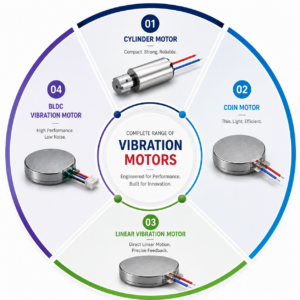
Cylinder Vibration Motor <- Click
Coin Vibration Motor <- Click
BLDC Vibration Motor <- Click
Linear Vibration Motor(LRA) <- Click
How a Cylinder Vibration Motor Works
Operating Principle of a Cylinder Vibration Motor
A Cylinder Vibration Motor, commonly known as an ERM (Eccentric Rotating Mass) Motor, generates vibration by converting electrical energy into controlled mechanical motion. Its operating principle is simple, efficient, and highly reliable, making it one of the most widely used vibration technologies in consumer electronics, medical devices, automotive systems, and industrial equipment.
When a DC voltage is applied, current flows through the motor windings, creating a magnetic field inside the motor. The interaction between the magnetic field generated by the stator and the permanent magnets attached to the rotor produces electromagnetic torque, causing the rotor to rotate at high speed.
Unlike a standard DC motor, a cylinder vibration motor is fitted with an eccentric rotating weight that is intentionally mounted off the motor’s rotational axis. As the rotor spins, this unbalanced mass continuously generates centrifugal force. Because the force changes direction throughout each revolution, it produces a continuous vibration that is transferred to the device housing.
The intensity of the vibration is determined by several engineering factors, including the mass of the eccentric weight, the distance of the weight from the shaft center, the rotational speed of the motor, and the structural characteristics of the motor itself. By optimizing these parameters, manufacturers can achieve the required vibration strength while maintaining compact dimensions, low power consumption, and long service life.
Cylinder vibration motors are designed to deliver rapid start-up characteristics and stable vibration performance. Their simple mechanical structure contributes to excellent durability, minimal maintenance requirements, and consistent operation over millions of vibration cycles. These characteristics make them particularly suitable for applications requiring dependable vibration alerts, tactile notifications, or mechanical vibration functions.
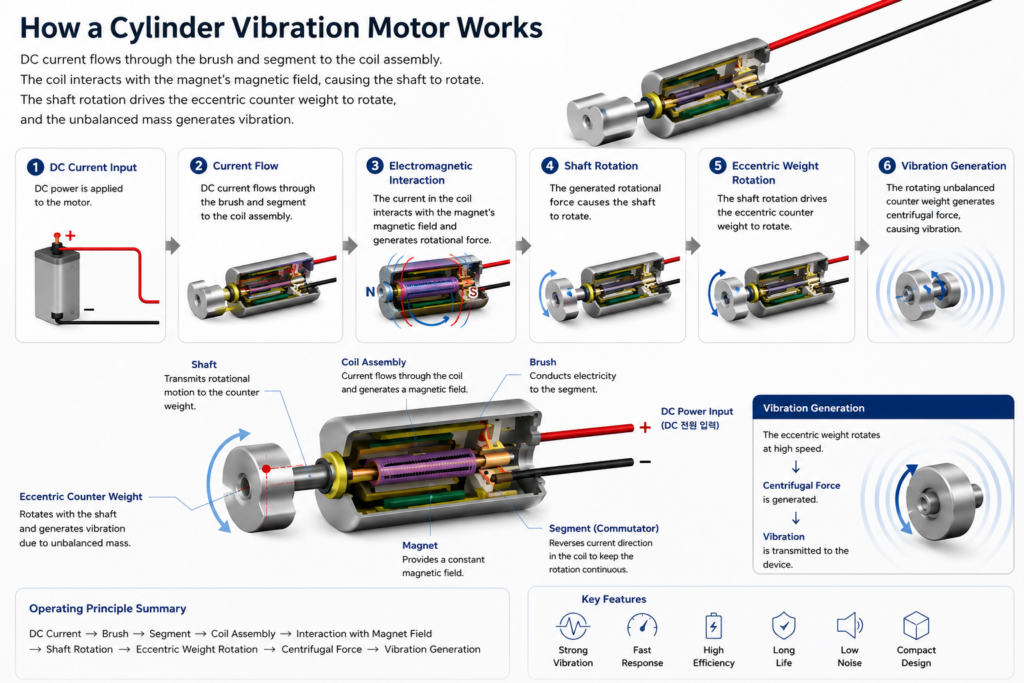
Step-by-Step Operating Process
1. Power Input
A DC power source energizes the motor, allowing electrical current to flow through the internal windings.
2. Electromagnetic Rotation
The interaction between the magnetic field of the permanent magnets and the energized coils generates rotational torque, causing the rotor to spin.
3. Eccentric Mass Rotation
An offset eccentric weight fixed to the rotor rotates together with the shaft at high speed.
4. Centrifugal Force Generation
As the eccentric weight rotates, it continuously creates changing centrifugal forces due to its off-center mass distribution.
5. Mechanical Vibration Output
The alternating centrifugal forces are transmitted through the motor housing to the surrounding device, producing smooth and consistent vibration.
Advantages of the ERM Operating Principle
- Simple and proven mechanical design
- Stable and reliable vibration output
- High vibration force in a compact package
- Fast response and rapid start-up
- Long operational lifetime
- Low power consumption
- Cost-effective manufacturing
- Easy integration into portable electronic devices
Typical Applications
Cylinder vibration motors are widely used in:
- Smartphones
- Wearable devices
- Medical equipment
- Beauty and personal care products
- Portable consumer electronics
- Smart home devices
- Automotive electronics
- Industrial handheld equipment
- Security systems
- IoT devices
Technical Summary
A Cylinder Vibration Motor operates by rotating an eccentric weight attached to the motor shaft. The resulting centrifugal force generates controlled mechanical vibration, providing a compact, reliable, and energy-efficient solution for haptic feedback and vibration alert applications across a wide range of industries.
How a Coin Vibration Motor Works
Operating Principle of a Coin Vibration Motor
A Coin Vibration Motor, also known as a Flat Vibration Motor or Pancake Vibration Motor, generates vibration by rotating an eccentric mass (counterweight) attached to the motor shaft. When electrical power is applied, the internal DC motor rapidly spins the off-center weight, creating an unbalanced centrifugal force. This continuously changing force is transferred to the motor housing and the host device, producing a smooth and consistent vibration.
Unlike conventional cylindrical vibration motors, the coin vibration motor features a compact, ultra-thin design that enables easy integration into space-constrained electronic devices. Its low profile makes it an ideal solution for smartphones, wearable devices, medical equipment, handheld terminals, gaming controllers, and various portable electronics.
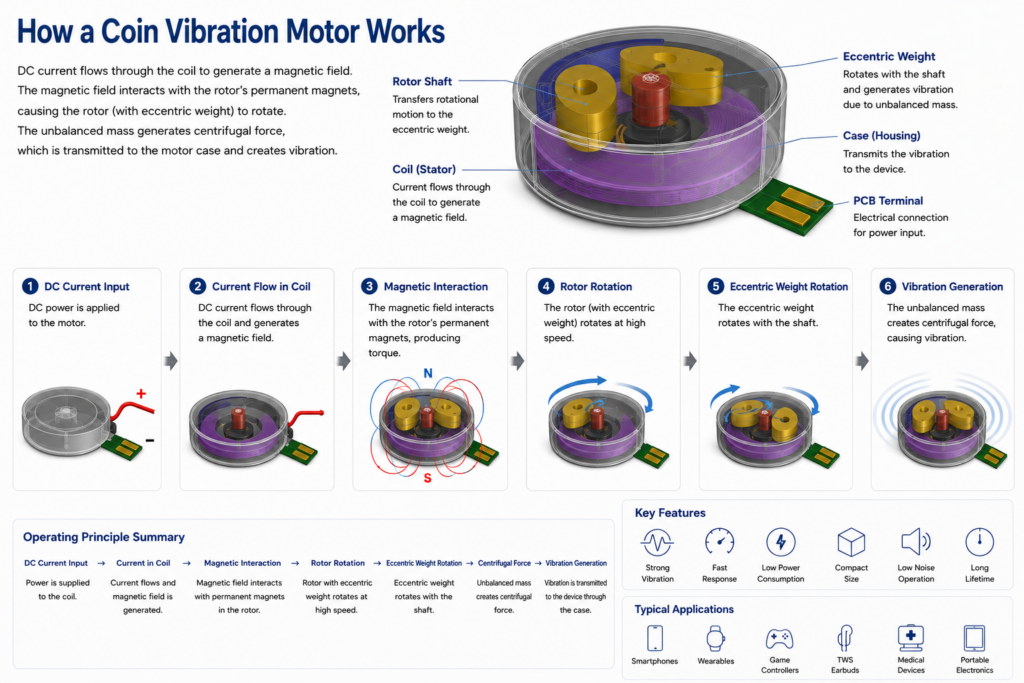
Step-by-Step Operating Process
1. Power Input
When a DC voltage is supplied, electrical current flows through the motor’s internal winding, generating an electromagnetic field.
2. Rotor Rotation
The electromagnetic force interacts with the permanent magnet, causing the rotor to rotate at high speed. Typical operating speeds range from 8,000 to over 15,000 RPM, depending on the motor design and application.
3. Eccentric Mass Rotation
A precisely balanced eccentric weight mounted on the rotor rotates together with the shaft. Since the weight’s center of gravity is intentionally offset from the rotational axis, centrifugal force is continuously generated during rotation.
4. Vibration Generation
The rotating eccentric mass creates a periodic unbalanced force in all directions. This force is transmitted through the motor housing into the host device, producing tactile vibration that can be easily perceived by the user.
5. Haptic Feedback
The generated vibration provides tactile feedback for notifications, touch confirmation, alarms, navigation guidance, and interactive user experiences. By adjusting the driving voltage or PWM control, vibration intensity and response characteristics can be optimized for different applications.
Key Features
- Ultra-thin and compact design for space-saving installation
- Fast start-up and rapid stopping response
- Stable and consistent vibration output
- Low power consumption with high efficiency
- Long operational lifetime and excellent reliability
- Low noise and smooth operation
- Easy integration with adhesive mounting options
- Suitable for high-volume automated assembly
Typical Applications
Coin vibration motors are widely used in:
- Smartphones and mobile phones
- Smartwatches and wearable devices
- Fitness trackers
- Medical and healthcare equipment
- Gaming controllers
- POS terminals
- Portable electronic devices
- Smart home products
- Industrial handheld equipment
- Consumer electronics requiring haptic feedback
How a Linear Vibration Motor (LRA) Works
Operating Principle of a Linear Vibration Motor
A Linear Vibration Motor, commonly known as a Linear Resonant Actuator (LRA), generates vibration through the controlled linear movement of an internal moving mass rather than by rotating an eccentric weight. Unlike traditional ERM (Eccentric Rotating Mass) motors, an LRA produces vibration by oscillating a magnetic mass back and forth along a single axis, delivering highly responsive, precise, and efficient haptic feedback.
The actuator consists of a moving mass integrated with a permanent magnet, a voice coil, precision springs, and a housing. When an alternating current (AC) signal is applied to the voice coil at the actuator’s resonant frequency, the magnetic interaction between the coil and the permanent magnet causes the moving mass to oscillate rapidly in a linear direction. This reciprocating motion generates a clean, sharp vibration that is transmitted directly to the host device.
Because the moving mass operates at its natural resonant frequency, energy loss is minimized, resulting in higher vibration efficiency, lower power consumption, faster response time, and superior tactile performance compared to conventional vibration motors.
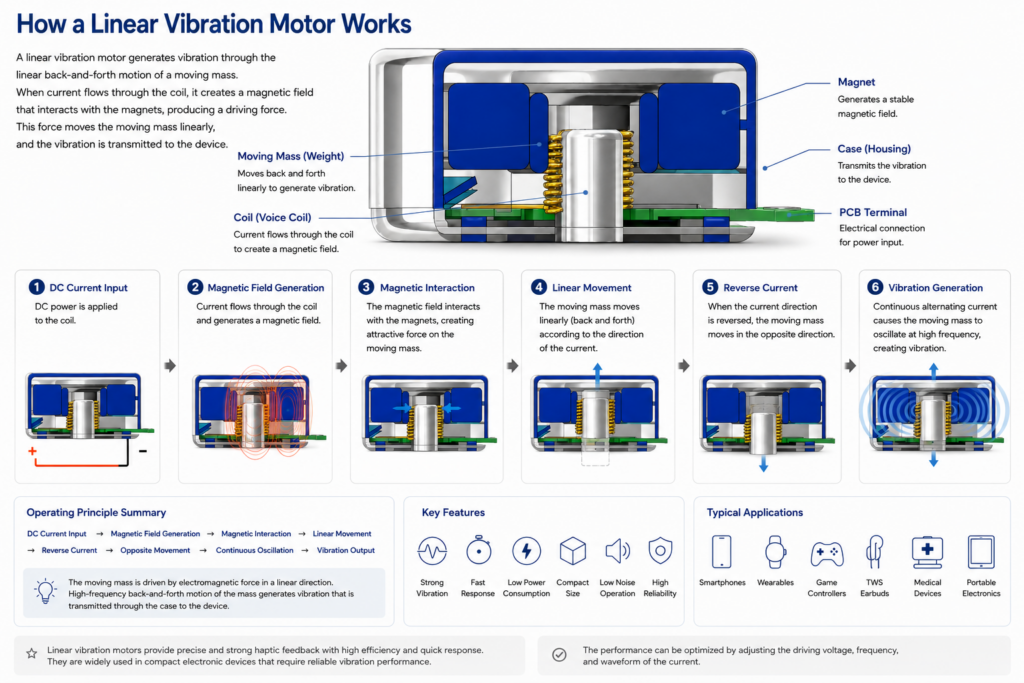
Step-by-Step Operating Process
1. Electrical Signal Input
The driver IC supplies an alternating current to the voice coil. The frequency of the input signal is carefully matched to the actuator’s resonant frequency to maximize vibration efficiency.
2. Electromagnetic Force Generation
As current flows through the voice coil, a magnetic field is generated. This magnetic field interacts with the permanent magnet attached to the moving mass, producing a precisely controlled electromagnetic force.
3. Linear Motion of the Moving Mass
The electromagnetic force drives the moving mass in a back-and-forth linear motion. Precision springs suspend the moving mass, allowing smooth oscillation while maintaining accurate alignment and mechanical stability.
4. Resonant Vibration
When the excitation frequency matches the actuator’s natural resonance, the moving mass oscillates with maximum amplitude and minimal energy consumption. Resonance enables the actuator to generate strong tactile feedback while maintaining high efficiency.
5. Haptic Feedback Output
The linear oscillation is transferred directly to the device housing, creating crisp, accurate, and repeatable tactile feedback. Users experience clear vibration responses for touch confirmation, notifications, alerts, gaming effects, navigation, and interactive user interfaces.
Advantages of Linear Vibration Motors
Compared with conventional ERM vibration motors, Linear Resonant Actuators provide numerous performance advantages:
- Extremely fast start-up and stopping response
- Precise and consistent haptic feedback
- Higher vibration efficiency at resonance
- Lower power consumption
- Reduced mechanical wear due to the absence of rotating eccentric weights
- Low operating noise
- Excellent durability and long service life
- Accurate vibration control using dedicated haptic driver ICs
- Enhanced user experience with programmable vibration effects
Typical Applications
Linear Vibration Motors are widely used in advanced electronic products requiring premium haptic feedback, including:
- Smartphones
- Tablet PCs
- Smartwatches
- Wearable devices
- Automotive touch displays and infotainment systems
- Medical equipment
- Gaming controllers
- AR/VR devices
- Industrial handheld terminals
- Smart home products
- Portable consumer electronics
- Human–Machine Interface (HMI) systems
How a BLDC Vibration Motor Works
Operating Principle of a BLDC Vibration Motor
A Brushless DC (BLDC) Vibration Motor generates vibration by combining advanced electronic commutation technology with a high-efficiency brushless motor and a precision-engineered eccentric weight. Unlike conventional brushed vibration motors that rely on mechanical brushes and a commutator, BLDC vibration motors use permanent magnets, stator windings, and an electronic driver circuit to produce smooth, reliable, and maintenance-free rotational motion.
As the rotor spins at high speed, the eccentric weight attached to the motor shaft creates an unbalanced centrifugal force. This continuously changing force is transferred to the motor housing and the host device, producing controlled vibration for haptic feedback, alerts, and industrial vibration applications.
Because there are no brushes or mechanical commutators, BLDC vibration motors offer significantly longer service life, lower electrical noise, higher efficiency, and superior operational stability compared with traditional brushed vibration motors.
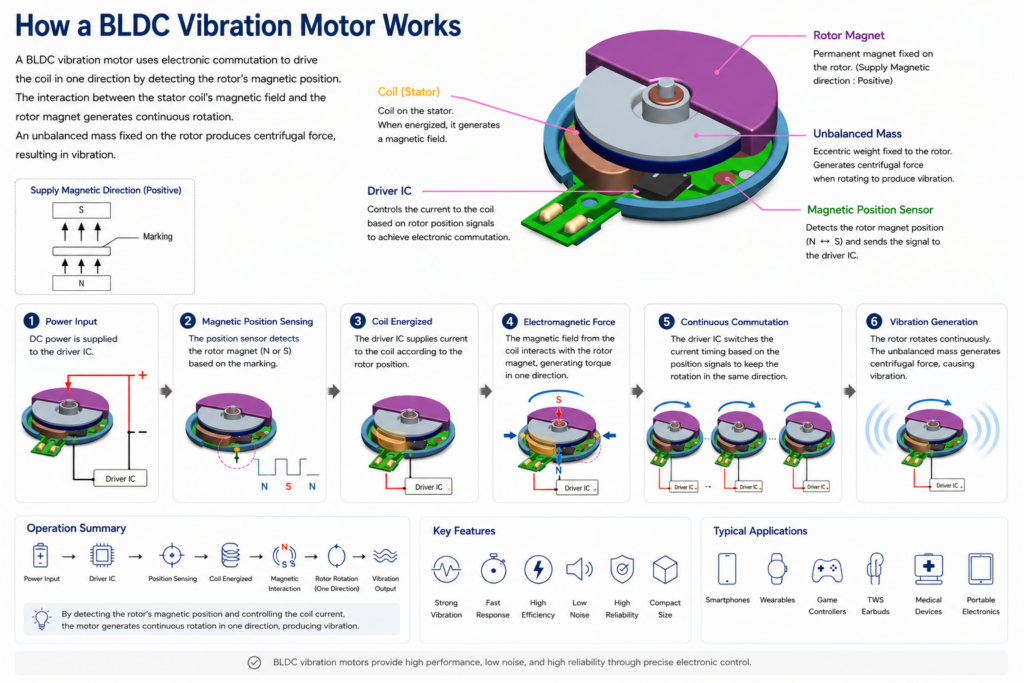
Step-by-Step Operating Process
1. Power Supply and Electronic Control
When DC power is applied, the electronic driver circuit energizes the stator windings according to the rotor position. Hall sensors or sensorless control algorithms continuously detect the rotor position to ensure accurate electronic commutation.
2. Electromagnetic Field Generation
The stator coils are energized sequentially, creating a rotating magnetic field. This magnetic field interacts with the permanent magnets mounted on the rotor, generating rotational torque without physical electrical contact.
3. High-Speed Rotor Rotation
The rotor begins rotating smoothly as the magnetic fields continuously change direction through electronic commutation. Since no brushes are involved, friction and electrical wear are greatly reduced, allowing stable high-speed operation and excellent efficiency.
4. Eccentric Weight Rotation
A precision-balanced eccentric weight is mounted on the motor shaft. As the shaft rotates, the off-center mass generates centrifugal force because its center of gravity does not coincide with the rotational axis.
5. Vibration Generation
The rotating eccentric weight continuously produces an unbalanced force that is transmitted through the motor housing into the host device. The vibration amplitude and frequency can be optimized by adjusting the motor speed, supply voltage, or driver control parameters.
6. Stable and Precise Haptic Output
The generated vibration delivers fast, repeatable, and consistent tactile feedback. Thanks to the brushless architecture and electronic speed control, BLDC vibration motors provide smoother operation, improved vibration consistency, and excellent long-term reliability.
Key Advantages of BLDC Vibration Motors
Compared with conventional brushed vibration motors, BLDC vibration motors provide numerous performance benefits:
- Brushless design with no mechanical commutator
- Significantly longer operational lifetime
- High efficiency and reduced power consumption
- Stable high-speed performance
- Low electrical noise and electromagnetic interference
- Excellent reliability for continuous operation
- Minimal maintenance requirements
- Precise electronic speed and vibration control
- Smooth and consistent vibration output
- Compact design suitable for high-density electronic products
Typical Applications
BLDC Vibration Motors are widely used in products requiring reliable, high-performance vibration and long service life, including:
- Smartphones and premium mobile devices
- Automotive touch displays and infotainment systems
- Wearable electronics
- Medical and healthcare equipment
- Industrial handheld terminals
- Smart home devices
- Gaming peripherals
- Portable consumer electronics
- Robotics and automation systems
- Security and communication equipment
- Human–Machine Interface (HMI) devices
- Professional electronic instruments
Description of the main characteristics of the DC vibration motor
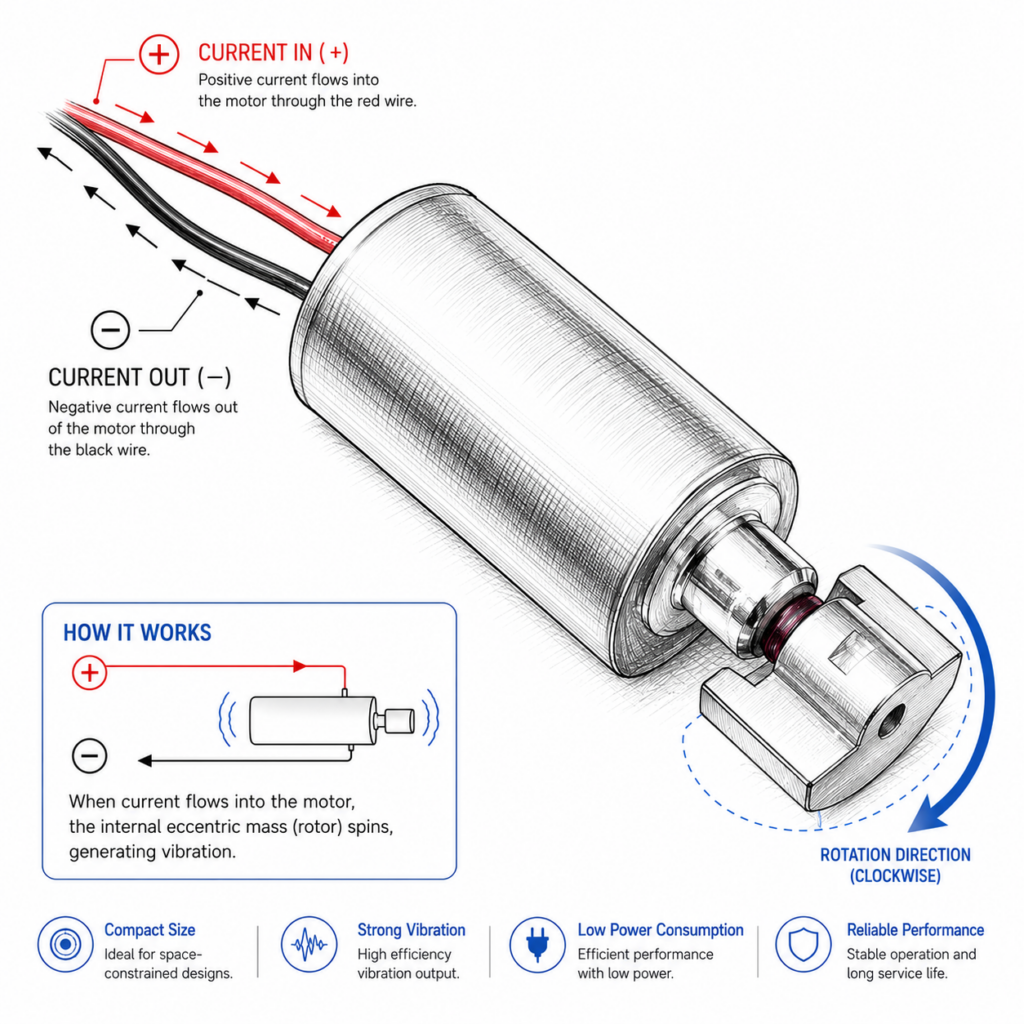
Rated Voltage is the nominal operating voltage at which the motor is designed to deliver its specified performance, including speed, current, torque, and efficiency under standard operating conditions.
Rated Current is the current consumed by the motor when operating at the rated voltage under specified operating conditions.
Rated Speed(rpm) is the rotational speed achieved by the motor at the rated voltage while delivering its rated performance.
Starting Voltage
The minimum voltage required for the motor to start rotating under no-load conditions.